Penny Wise, Pound Foolish: The True Cost of Budget Furniture Over Time

There is a particular satisfaction in finding a sofa for $400 or outfitting an entire office reception area for under $2,000. The savings feel immediate, tangible, and genuinely smart. Yet furniture buyers—whether they are homeowners refreshing a living room or operations managers equipping a corporate campus—frequently discover that the lowest sticker price rarely corresponds to the lowest total expenditure. The gap between what furniture costs to acquire and what it costs to own is where budget decisions either prove their wisdom or expose their flaw.
At Traders Furniture, we work with a broad spectrum of clients: residential consumers decorating their first homes, interior designers sourcing pieces for high-turnover hospitality projects, and procurement officers managing multi-location commercial portfolios. Across all of these contexts, one pattern emerges with remarkable consistency—the furniture that appears least expensive at purchase tends to generate the highest cumulative costs over any meaningful period of time.
Understanding the Replacement Cycle Problem
The most significant hidden cost of low-quality furniture is not repair. It is replacement.
Consider a common scenario in the commercial sector. A regional property management company outfits a leasing office with entry-level task chairs priced at $85 per unit. The chairs look professional on day one. By month fourteen, seat cushions have compressed beyond comfortable use, armrests have loosened, and the caster wheels have begun to fail. By month twenty-four, the chairs are being replaced entirely.
Now run the math. At $85 per chair, replaced every two years over a ten-year span, the company spends $425 per workstation on seating alone—not counting disposal fees, staff time spent coordinating replacements, or the subtle but real productivity cost of employees working in uncomfortable chairs. A mid-range task chair priced at $280 with a seven-year expected service life costs $400 over the same decade. A commercial-grade chair at $450 with a validated ten-year lifespan costs exactly $450.
The budget option, purchased five times over, costs nearly as much as the premium option purchased once—and delivers a substantially inferior experience throughout.
Residential Realities: The Living Room Case Study
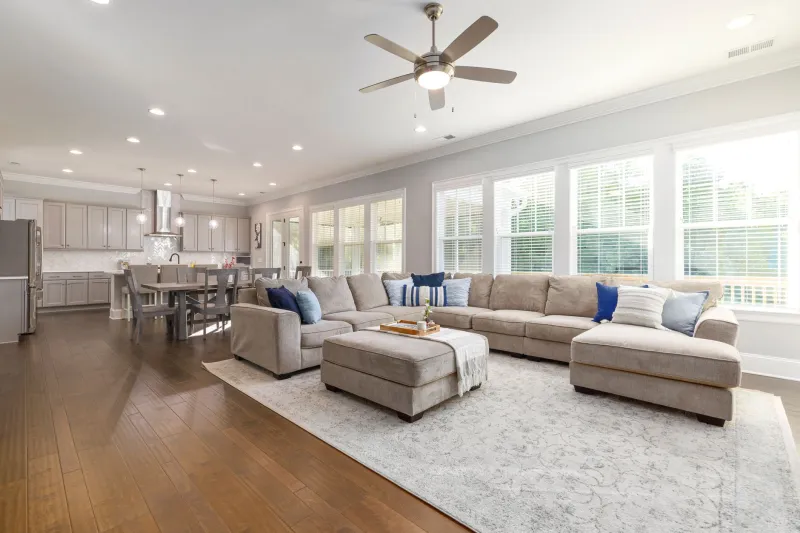
The same economic dynamic plays out in residential settings, though the emotional dimensions are often more pronounced. A family in suburban Atlanta purchased a fabric sectional from a discount big-box retailer for $799. Within eighteen months, the frame had begun to sag noticeably on one side, the cushion fill had flattened, and a seam had separated along the chaise portion. A furniture repair technician quoted $340 for partial restoration—nearly half the original purchase price—with no guarantee the underlying frame issues would not recur.
The family ultimately replaced the sectional at the three-year mark, spending $950 on a second budget piece. Six years into their homeownership, they had spent $2,089 on a single furniture category and still did not own a piece they were satisfied with.
A mid-range sectional from a reputable supplier, priced at $1,600 to $2,200, would have served that same household for eight to twelve years with standard care. The total cost of ownership—calculated honestly—favors the quality investment by a substantial margin, even before accounting for the intangible value of not managing furniture failures during those years.
The Commercial Amplification Effect
For businesses operating at scale, these dynamics amplify dramatically. A hotel group furnishing 200 guest rooms with budget-grade case goods—dressers, nightstands, and desk units—at an average of $1,200 per room spends $240,000 upfront. If those pieces require replacement after five years due to delamination, hardware failure, and surface wear common to entry-level furniture, the group faces another $240,000 expenditure—plus the significant operational disruption of refurnishing occupied properties.
Commercial-grade furniture built for high-rotation environments, priced at roughly $1,800 per room, represents a $360,000 initial investment but carries a ten-to-fifteen-year expected lifespan under hospitality conditions. Over a decade, the cost differential between the two approaches is not $120,000 in favor of the budget option. It is $120,000 in favor of the quality option—because the budget rooms have already been refurnished once and are approaching a second cycle.
This is what procurement professionals in the hospitality and commercial real estate sectors refer to as the total cost of ownership calculation, and it is the single most important framework for evaluating any large-scale furniture acquisition.
Environmental Costs That Don't Appear on Invoices
Beyond the financial ledger, there is an environmental accounting that increasingly matters to consumers and businesses alike. Furniture waste is a significant contributor to US landfill volume. The Environmental Protection Agency has estimated that Americans discard tens of millions of tons of furniture annually, with a substantial portion of that waste attributable to pieces that were never designed to last.
Manufacturing furniture requires energy, raw materials, water, and transportation. When a piece of furniture is replaced every two to three years rather than lasting a decade, the environmental cost of that product is effectively multiplied. For businesses with sustainability commitments—or for residential consumers who prefer to minimize their environmental footprint—this dimension of the durability question carries genuine weight.
Choosing quality furniture is, in a meaningful sense, an act of environmental responsibility. Fewer replacements mean fewer manufacturing cycles, less shipping, and less material entering the waste stream.
Where the Value Threshold Actually Sits
None of this is an argument that every furniture purchase must be made at the premium tier. The quality spectrum is wide, and the sweet spot for most buyers—both residential and commercial—lies in the mid-range, where construction integrity, material quality, and warranty support converge without requiring a luxury budget.
The practical guidance that emerges from analyzing total cost of ownership data is relatively straightforward: identify the pieces in any environment that will bear the most use and stress, and prioritize quality investment there. Dining chairs in a family home. Task seating in an office. Lobby seating in a hotel or corporate campus. Bed frames and case goods in rental properties. These are the categories where durability failures are most disruptive and replacement costs accumulate most rapidly.
For lower-use accent pieces—a decorative side table in a guest room, a bench at the foot of a bed—a more economical approach carries less risk, because the functional demands are correspondingly lower.
Making the Investment Case Internally
For procurement managers and operations directors, one of the persistent challenges is making the case for quality furniture investment to financial stakeholders who focus on line-item costs rather than lifecycle economics. The most effective approach is to present the total cost of ownership analysis directly, using your own organization's replacement history as evidence.
If your facilities team has replaced the same category of furniture two or three times in the past decade, that history is your argument. Document the acquisition costs, the disposal costs, the staff time, and the operational disruption. Present the alternative—a single quality purchase with a ten-year expected lifespan—against that cumulative figure. The math, presented clearly, tends to shift the conversation.
At Traders Furniture, we support this process by providing detailed product specifications, warranty documentation, and guidance on commercial-grade versus residential-grade construction standards. Understanding what you are buying—and why it is built the way it is—is the foundation of any sound furniture investment decision.
The Bottom Line on Bargains
Budget furniture is not inherently a poor choice. It is a poor choice when it is selected without accounting for how long it will actually last, what it will cost to maintain, and what it will cost to replace. When those factors are incorporated honestly into the purchasing decision, quality furniture—at the mid-range or premium tier—demonstrates its value with considerable clarity.
The durability of a piece of furniture is not an abstract virtue. It is a financial asset. Treat it accordingly.